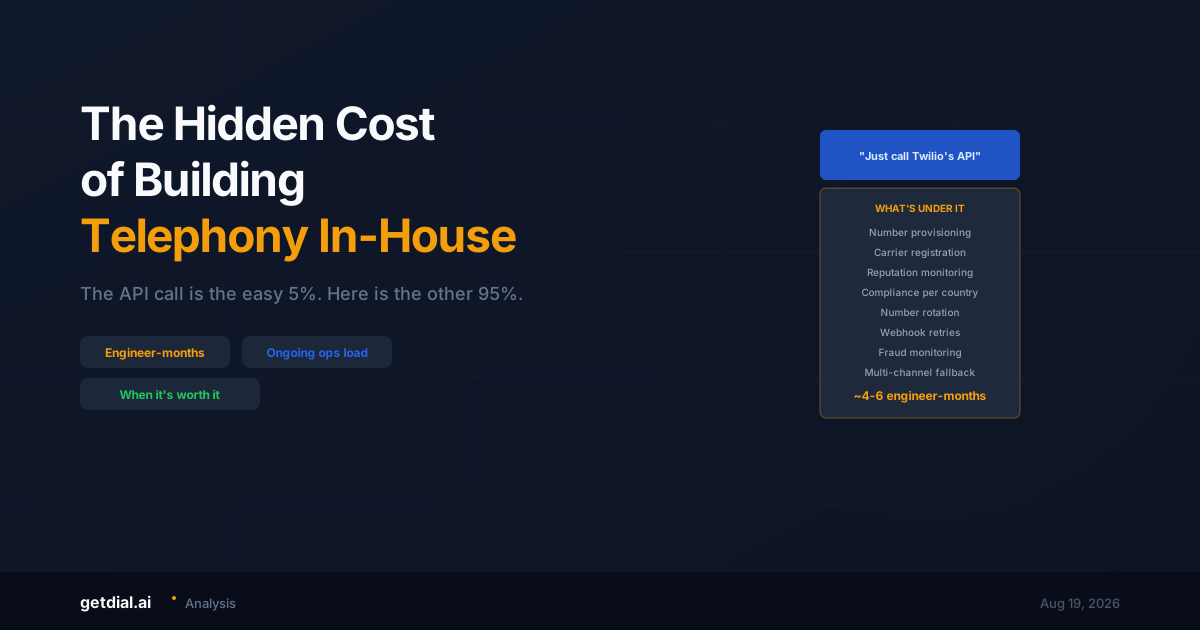
"We'll just call the API" is how almost every team scopes the communication layer of an AI agent product. It is also how almost every team ends up with a part-time telephony team they never meant to hire.
The API call really is an afternoon of work. Placing a call, sending an SMS, receiving a webhook - a junior engineer can wire that up before lunch. The part nobody scopes is everything that has to be true for that API call to keep working reliably, for real users, for more than a few weeks.
What the demo doesn't show you
A demo needs one number that works once. A product needs numbers that keep working for months, across however many countries your users are in, under load patterns nobody designed for.
Here is what sits underneath a single "send a message" call that actually holds up in production:
Number provisioning and lifecycle. Numbers expire, get reassigned, need renewal. Someone has to track which numbers exist, what they cost, and what happens when one needs to be replaced mid-campaign.
Carrier registration. Sending meaningful volume in the US requires campaign registration. Other countries have their own registries, their own approval queues, their own rejection reasons that read like a foreign bureaucracy because they are one. This is not a one-time setup - it recurs every time you add a use case or a country.
Reputation monitoring. A phone number's deliverability degrades based on how it's used, and nothing tells you this is happening except a slow decline in answer rates or delivery rates that looks, at first, like your product got worse. Catching it requires instrumentation nobody builds until after the first time it costs them a quarter of conversions.
Number rotation. Numbers that carry a lot of automated traffic need to be retired and replaced before they degrade, not after. This is an ongoing operational cadence, not a feature you ship once.
Compliance, per country. Every market has its own rules for what's required before a message or call can legally reach someone there - consent requirements, quiet hours, registries you must check, disclosure requirements for AI-generated calls. This list does not shrink over time. It only grows as you expand.
Webhook reliability. Delivery status, inbound replies, call events - all arrive as webhooks that can be delayed, duplicated, or dropped. Building idempotent handling for that is invisible work until the day a duplicate webhook double-charges a customer.
Fraud exposure. Any system that lets an account place outbound calls or send outbound messages is a target for abuse - the same infrastructure that serves real users can be pointed at premium-rate destinations or used to blast unregistered traffic. Someone has to watch for it, because the origination cost lands on whoever owns the number.
None of this is optional once you have real users. All of it is invisible in a demo.
The honest cost
Ask an engineering team to build a minimum version of the list above - provisioning, basic compliance for one country, rotation, retry-safe webhooks - and a realistic estimate is four to six engineer-months before it is solid enough to trust with real customer traffic. That is before covering a second country, before building fraud monitoring, before the first incident teaches you what you missed.
And it does not stop once it ships. This is not a project with an end date. New countries mean new compliance requirements. Carrier rule changes require redoing registration work. A degrading number needs someone watching for it, always. The ongoing tax is real and it does not show up in the initial estimate.
Compare that to the actual differentiated work of an AI agent product: the reasoning, the conversation design, the task the agent is actually good at. Telephony infrastructure is not that. It is necessary, invisible when it works, and expensive when it doesn't - the textbook definition of a problem worth not owning.
When building it yourself actually makes sense
This is not an argument that building is always wrong. It makes sense when telephony infrastructure genuinely is your product - if you are building the platform other companies build on, the infrastructure work is the business. It can also make sense at a scale where the unit economics of owning your own carrier relationships beat any platform's margin, which is a real threshold but a much higher one than most teams assume when they start.
For almost everyone else - a team building an agent whose value is in what it does on a call, not in how the call gets placed - the infrastructure is a tax, not a feature.
What "buy" actually buys you
The honest pitch for a platform like Dial is not "faster to ship." It's narrower than that: the list above stops being your team's problem. Provisioning, registration, reputation, rotation, per-country compliance, fraud monitoring - that becomes infrastructure you consume through an API, maintained by people whose whole job is keeping it correct as the rules change under everyone's feet.
The afternoon it takes to call the API was never the real cost. The real cost is everything that has to keep being true after that, indefinitely, for every number, in every country your product ends up in. Decide who owns that before you decide how to ship the first call.