Why AI Agents Need Real Phone Numbers
Most AI agents live entirely in text. But the real world runs on phone calls, SMS verification codes, and WhatsApp messages. Here's why giving your agent a real number changes everything.
Guides, tutorials, and updates from the Dial team.
Featured
Most AI agents live entirely in text. But the real world runs on phone calls, SMS verification codes, and WhatsApp messages. Here's why giving your agent a real number changes everything.
Jensen Huang, Sam Altman, and Marc Andreessen all landed on the same number independently: one human, one hundred AI agents. The math is not a forecast. It's already happening in early enterprise deployments — and our communication infrastructure is completely unprepared.
All posts
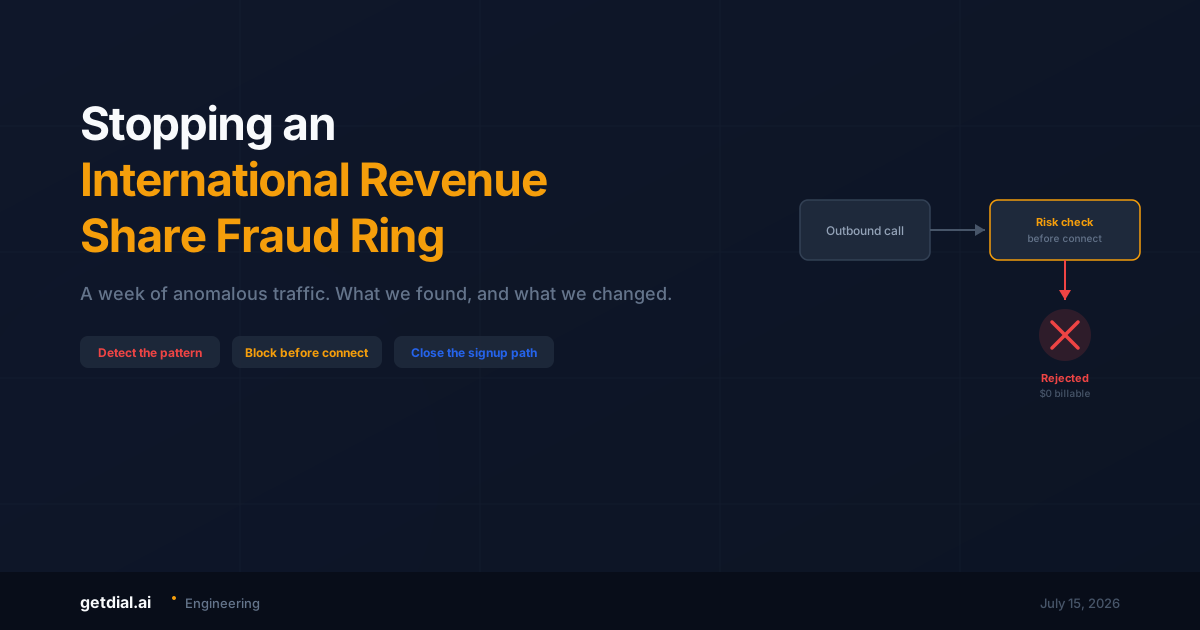
For about a week, a fraud ring tried to route free Dial accounts into a rotating set of international premium-rate numbers to collect revenue share at our expense. Here is what International Revenue Share Fraud actually is, how we caught it, and what we changed.
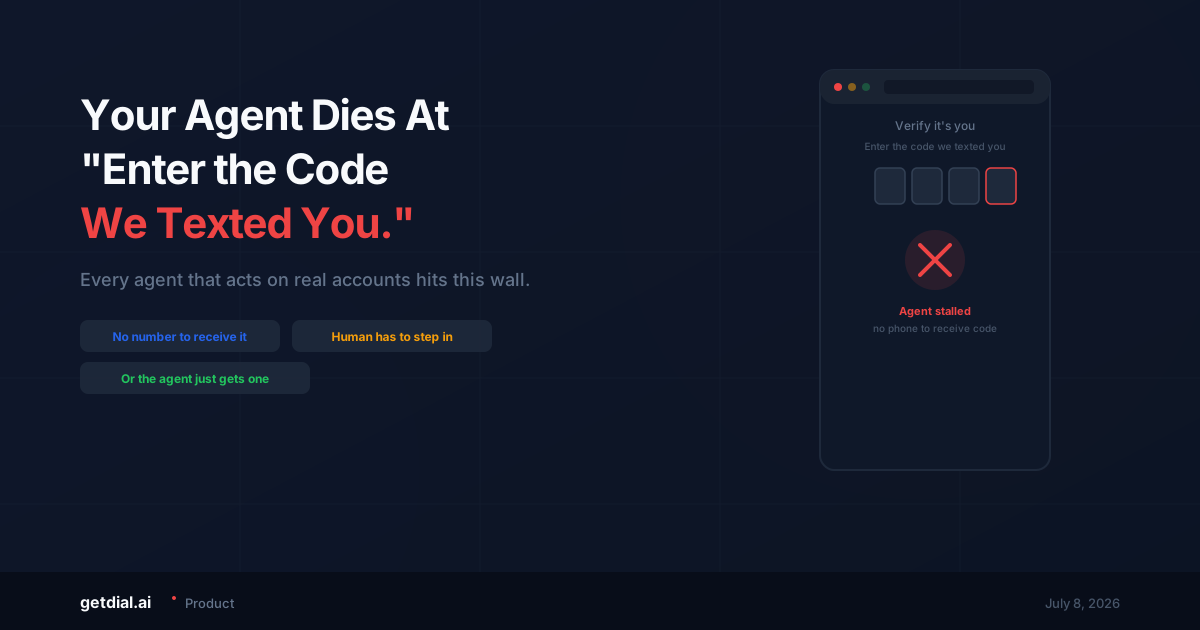
Your agent just navigated a signup form, filled in every field correctly, and clicked submit without a single mistake. Then it hit a text box asking for a six-digit code, and the whole task ended right there. This is the most common failure mode nobody talks about.
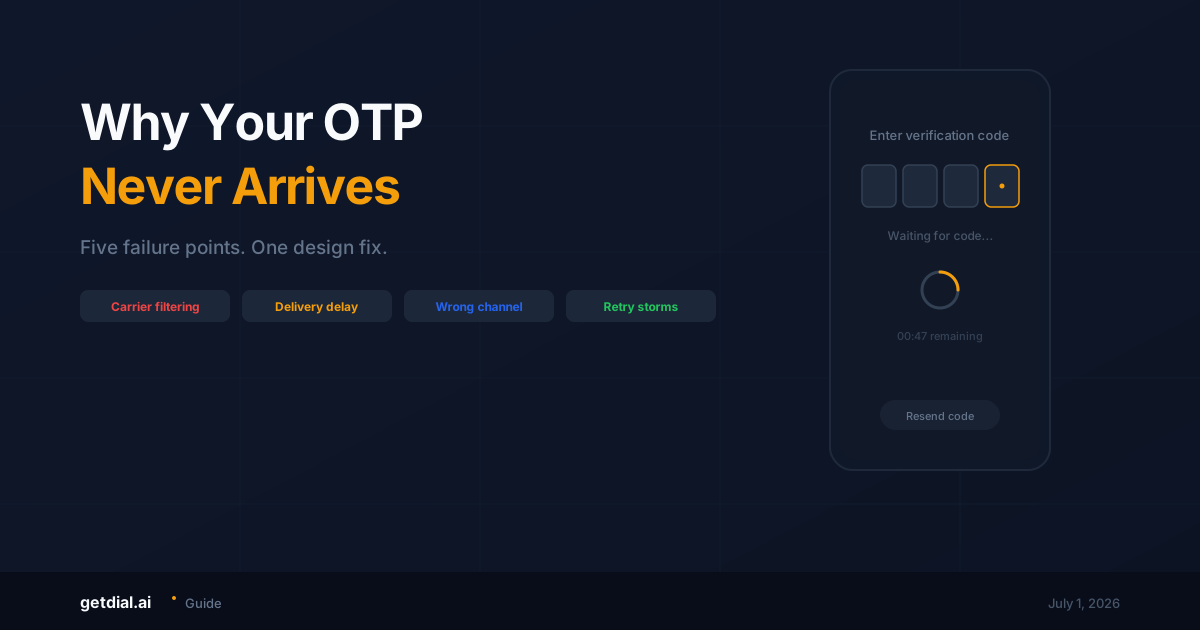
The verification code was sent two minutes ago. The user is still staring at four empty boxes. It is not one bug - it is five different failure points stacked on top of each other, and most verification flows are designed around none of them.
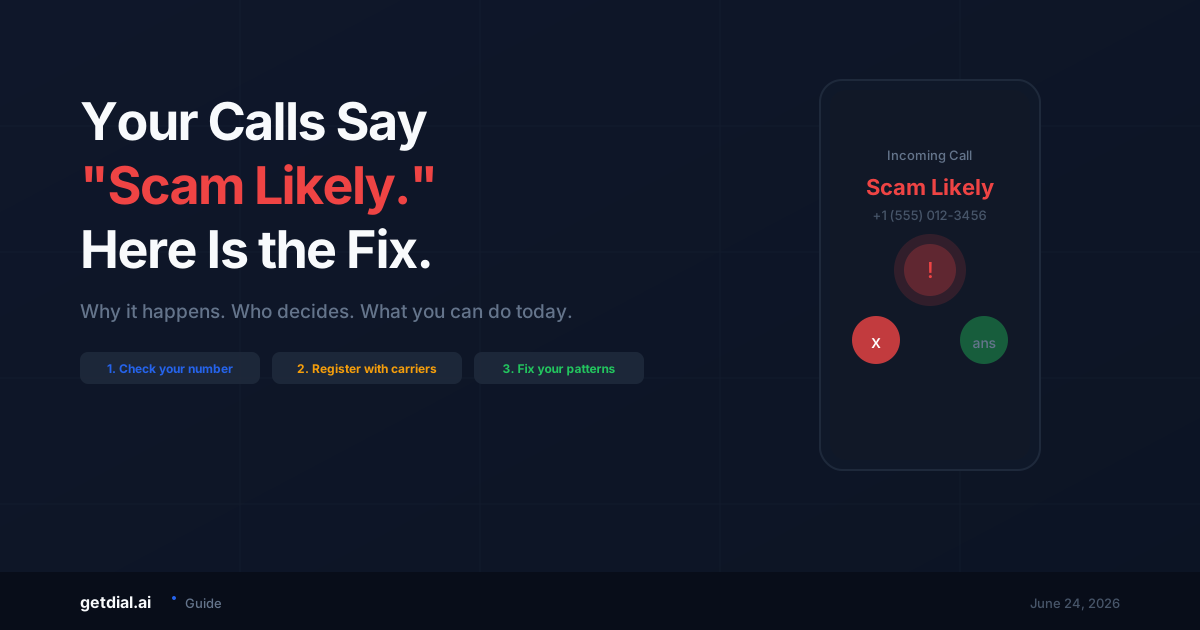
Your AI agent's calls are reaching people with a "Scam Likely" label - or not reaching them at all. Here is what causes it, what Dial handles on your behalf, and the one thing only you can control: how your agent actually calls.
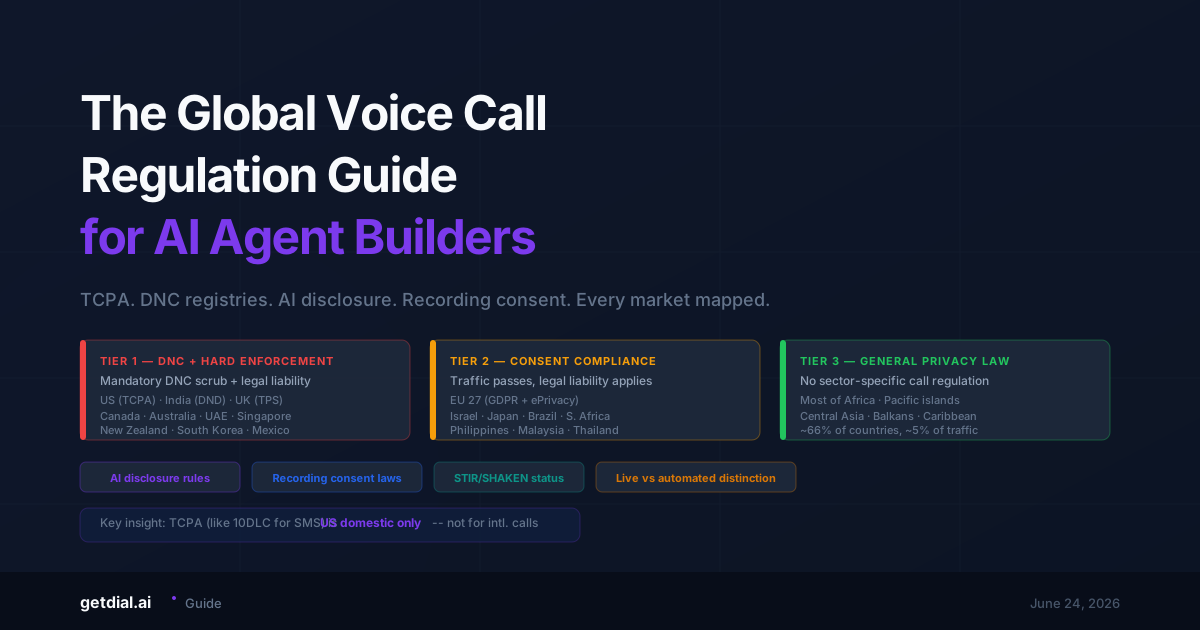
TCPA applies to calls to US numbers - not calls from US numbers to international recipients. The rules for AI voice agents are more complex than SMS: live vs. automated distinctions, AI disclosure mandates, recording consent laws, and DNC registries in 20+ countries. Every major market mapped.
10DLC is a US domestic regulation. It applies when your US long code sends to a US number - not when you send to Israel, India, or anywhere outside the US. But the destination country has its own rules. Here is every major market mapped, with the exact regulation name and enforcement type.
The global phone numbering system was designed in 1984 for humans calling other humans. AI agents are consuming numbers at a rate the infrastructure was never built for - and the bottleneck is not the number pool itself. It is the routing databases, registration queues, and reputation systems underneath it.
Everyone is benchmarking AI calling against human agents. The actual competition is the voicemail box. 34% of outbound AI calls go straight to it, and all your conversation design doesn't help a single one of them.
Carrier analytics systems score every number before it rings. AI agents trip every signal: volume spikes, low answer rates, no inbound history, identical audio. Most developers never find out — they just see no answer in the logs.
A 2025 SurveyMonkey study found 79% of Americans prefer human customer service over AI. Most developers read that as a ceiling. It isn't. People don't hate AI calls — they hate bad AI calls. Here's the difference, and exactly what to build differently.
Most developers building AI voice agents don't know which protocol stack they're on — or what that choice costs them in latency, reliability, and reach. Here's a plain-language breakdown of the three layers, how they interact, and what the right architecture looks like in 2026.
For 15 years, RCS sat mostly dormant — a richer SMS standard that carriers kept implementing unevenly and Apple refused to support. In September 2024, iOS 18 shipped with RCS. Global traffic jumped fivefold. Here's what actually changed, why it matters for AI agents, and what the infrastructure gap still is.
The internet needed TCP/IP. The web needed HTTP. The cloud needed virtualization. Every technology wave has required a new infrastructure layer to be built before the wave could break at scale. The agentic era is no different — and the infrastructure layer it needs doesn't exist yet.
Article 52 of the EU AI Act creates mandatory disclosure requirements for AI systems interacting with humans in real-time conversational contexts. If your agent makes calls or sends messages to EU residents, you have a compliance obligation that most engineering teams haven't addressed.
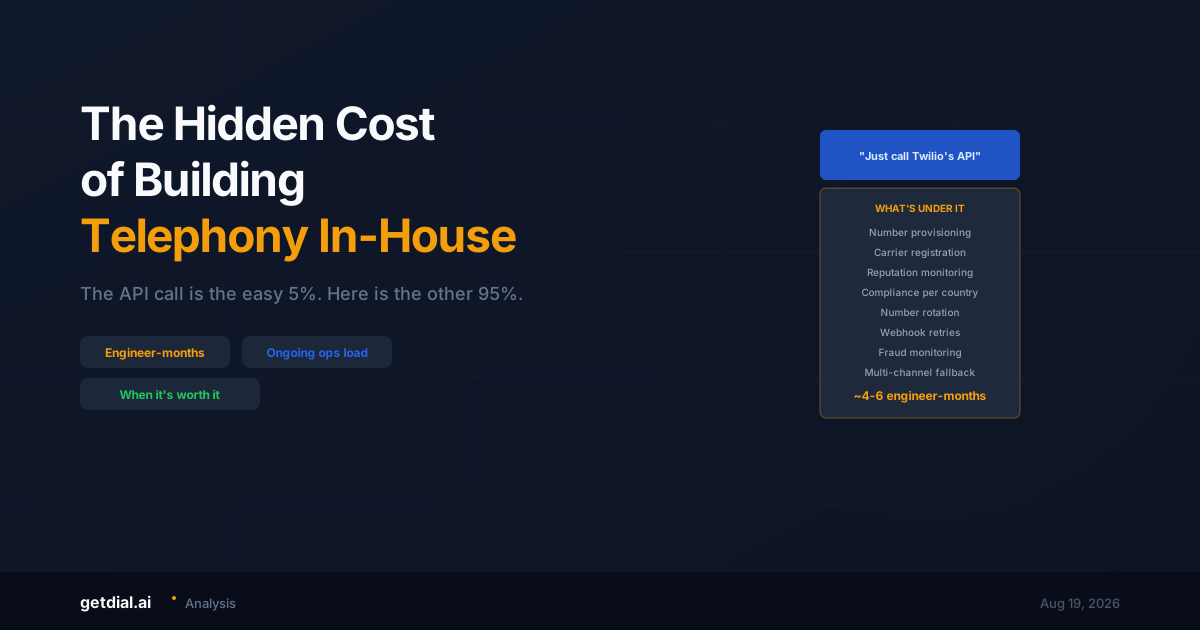
The demo works. The prototype impresses. Then you try to ship it, and you discover that between your working agent and a production deployment that can actually communicate, there's 6–10 weeks of carrier registration, domain warm-up, and compliance setup. Most teams don't see it coming.
A phone number is identity rooted in physical possession — you have a SIM card, so you have a number. AI agents don't have SIM cards. They need identity rooted in cryptographic proof — persistent across deployments, portable across infrastructure, verifiable by anyone.
The CPaaS market was valued at $18 billion in 2024 — built on human communication at human scale. If the 1:100 agent ratio materializes, agent communication will dwarf that by an order of magnitude. The agent communication market doesn't have a name yet. But the math is not hard.
If your agent only communicates via SMS and voice, it's invisible to most of the world. WhatsApp has 2 billion active users in 180+ countries. Outside North America, it's the default communication channel — not SMS. Building for agents without WhatsApp is building for half the planet.
When AI agents coordinate with each other, they do it through API calls and shared state stores. Unverified. Unauditable. Invisible to the humans overseeing the system. ACES defines an authenticated, auditable, session-persistent primitive for agent-to-agent interaction — and it may be the most important channel nobody is talking about.
For a decade, voice calls felt like a legacy channel. Then LLMs got fast enough for real-time conversation, and suddenly calling is the most natural interface again. There's a reason ACES starts with phone — and it's not nostalgia.
A phone call, an SMS, an email, and a WhatsApp message are not just different channels. They're different protocols, different encoding, different compliance requirements, different trust frameworks. The Channel Abstraction Layer normalizes all of them into a single interface so your agent never has to care.
TCPA, CAN-SPAM, GDPR, and the EU AI Act apply simultaneously to AI agents communicating across channels. None of these frameworks were written with agents in mind. The right answer isn't a bigger legal team — it's compliance baked into the infrastructure layer.
Twilio is excellent infrastructure. It's also human infrastructure — every rate limit, reputation model, and identity primitive it exposes was designed for a world with humans on at least one end of every communication. For agents, that's the wrong starting point.
Every team building AI communication agents runs into the same five failure modes, in roughly the same order. Reputation decay. Volume throttle. Identity ambiguity. Cross-channel fragmentation. Compliance exposure. None of them are bugs. All of them are infrastructure.
All human communication on Earth — every SMS, email, WhatsApp message, and phone call — totals roughly 437 billion events per day. AI agents, at the 1:100 ratio, will generate 6.5 trillion. That's not a scalability challenge. It's a category error.
The phone number was the identity anchor of the telephone era. The email address was the identity anchor of the internet era. The Agent Communication Number (ACN) is the identity anchor for the agentic era — persistent, cryptographically rooted, and designed to work across every channel simultaneously.
STIR/SHAKEN is a real improvement for phone call authentication. But it only answers one question: did this call originate from a legitimate carrier customer? It says nothing about whether the caller is a human or an agent, what the agent is authorized to do, or whether the communication is legitimate.
Your agent called a lead last Tuesday about a contract. The lead texts back on Saturday with a question. Your agent has no idea who this is or what they discussed. Every channel switch is a cold start. This is the defining failure mode of agent communication today — and it's entirely infrastructure.
A phone number used by an AI agent for outbound calls accumulates spam complaints at 10–100× the rate of a human-operated number. Carriers update their databases within hours. A clean number on Monday is flagged by Wednesday. Most teams never see it coming until calls stop connecting.
Teams build email agents, those agents send at agent scale, and one day the CEO notices that the company's email isn't being delivered. It takes weeks to recover from domain blacklisting. Most teams never see it coming.
AI agents go from zero to deployed in the time it takes to run a pip install. Getting permission to use a phone number for that agent takes 6–10 weeks. This is not a minor inconvenience. It's a categorical incompatibility with how agents work.
Phone numbers assume SIM card possession. Email assumes human typing patterns. SMS rate limits assume human-speed outreach. Every layer of communication infrastructure was built with one unexamined assumption: the entity communicating is a person.
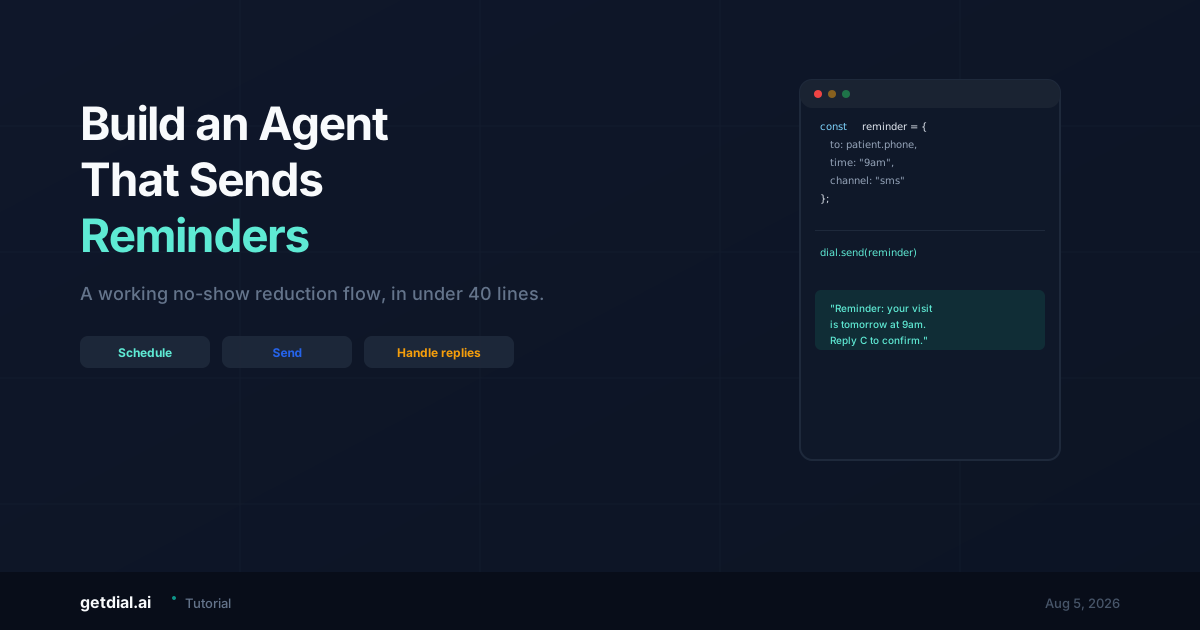
A step-by-step tutorial on automating SMS verification workflows. We'll sign up for a real service, intercept the OTP, and complete verification — all from a Claude Code session.